
Spring Water Testing for Almond Orchards: What to Check Before Irrigation
Before you turn on the pump, know what your spring is actually delivering. Here are the water tests that matter for almonds and the warning signs worth catching early.
A spring feels like the most trustworthy water on the farm. It arrives cold, clear and consistent, year after year, without a pump invoice attached. That reliability is real — but it can also be misleading. Water that has spent years moving through rock picks up whatever that rock contains, and the same spring that has never caused a visible problem can still be adding salt, boron or bicarbonate to your soil in slow, cumulative doses.
Almonds are a valuable, long-lived crop, and irrigation water is one of those inputs where a small amount of information up front saves a great deal of guesswork later. A basic laboratory panel costs far less than a replant, and it turns a vague worry into a set of numbers you can plan around. What follows is what to test, how to interpret it, and what the orchard itself will tell you between lab reports.
Start With the Source, Not the Sample
Before you fill any bottle, walk the spring. Note what the water passes through on its way to the surface — limestone, volcanic rock and alluvial ground give very different water. Look uphill and upslope for anything that could reach the recharge area: livestock, a neighbour's fertiliser store, a septic system, a road with winter salt, intensive cropping.
Watch the flow for a few minutes and note whether it changes. Springs fed by deep, slow pathways tend to be chemically stable and physically clean. Springs that respond quickly to rain are a different animal: they carry sediment after storms, their chemistry swings, and their microbial quality is far less predictable. That difference alone should shape how often you test. If your spring turns cloudy within a day of heavy rain, you have a shallow, fast pathway, and you should treat the water accordingly.
The Tests Worth Paying For
Ask the lab for an irrigation water panel rather than a drinking water panel; they are built for different questions. At minimum, you want the following.
- Electrical conductivity (EC) or total dissolved salts. The single most useful number on the report. It approximates how much salt the water carries and therefore how much you add with every irrigation.
- pH. Relevant both to soil chemistry and to how well your fertigation mixes behave.
- Calcium, magnesium, sodium and potassium. These let the lab calculate the sodium adsorption ratio (SAR), which flags sodic-water risk and structural damage to clay soils.
- Chloride. Almonds are notably sensitive to chloride, and it accumulates in leaf margins before it ever shows in the soil test.
- Boron. Needed in trace amounts, toxic in small excess. Boron is the nutrient most often overlooked in irrigation reports and one of the most common causes of unexplained leaf burn in almonds.
- Bicarbonate, carbonate and alkalinity. High bicarbonate raises soil pH over time, can lock up iron and zinc, and precipitates as lime scale in drip lines.
- Nitrate-nitrogen. Not a contaminant in this context but a nutrient input you should count in your seasonal nitrogen budget.
- Sulphate. Completes the salt picture and matters for gypsum and amendment decisions.
- Iron and manganese. Low health concern, high practical concern: they feed the bacteria that clog emitters and leave rust staining in filters and lines.
- Total coliforms and E. coli. Mainly a hygiene indicator. Worth including if water is used near harvest or for dust control, and worth discussing with your buyers, since requirements vary by market.
One full panel at the start, and then again whenever something changes — a new capture point, a shift in flow, a neighbouring development — is a sensible baseline. If the water is expensive to test, the cheaper annual option is EC, pH and boron, with the full panel every few years.
Reading the Results With Almonds in Mind
Salinity
Almonds sit in the moderately sensitive range, so yield loss can begin at salinities that would not trouble a date palm or a barley crop. Judge the water together with your soil and your leaching fraction rather than in isolation. A moderately salty water on a deep, well-drained sandy loam with winter rainfall is a different proposition from the same water on a shallow clay soil with no leaching. If your EC is climbing, plan extra leaching and monitor the root zone, not just the pipe.
Sodium, Chloride and Boron
These three are the ones that bite quietly. Sodium and chloride damage shows first as marginal and tip burn on older leaves; boron toxicity looks similar but often yellows the leaf margins and progresses inward. Because all three accumulate, the symptoms appear late, usually a season or two after the water quality changed. If any of them is elevated in your report, ask for leaf tissue analysis as well — the water tells you what is going in, the tissue tells you what the tree has actually taken up.
Bicarbonate and pH
High alkalinity is a slow tax. It pushes soil pH upward, reduces the availability of micronutrients, and creates the white scale you find on emitters and filters. In severe cases, acid injection into the irrigation line is a standard remedy — but have that decision made by someone who has seen your full water report and soil test, not by a product label.
Physical and Biological Checks a Lab Won't Do for You
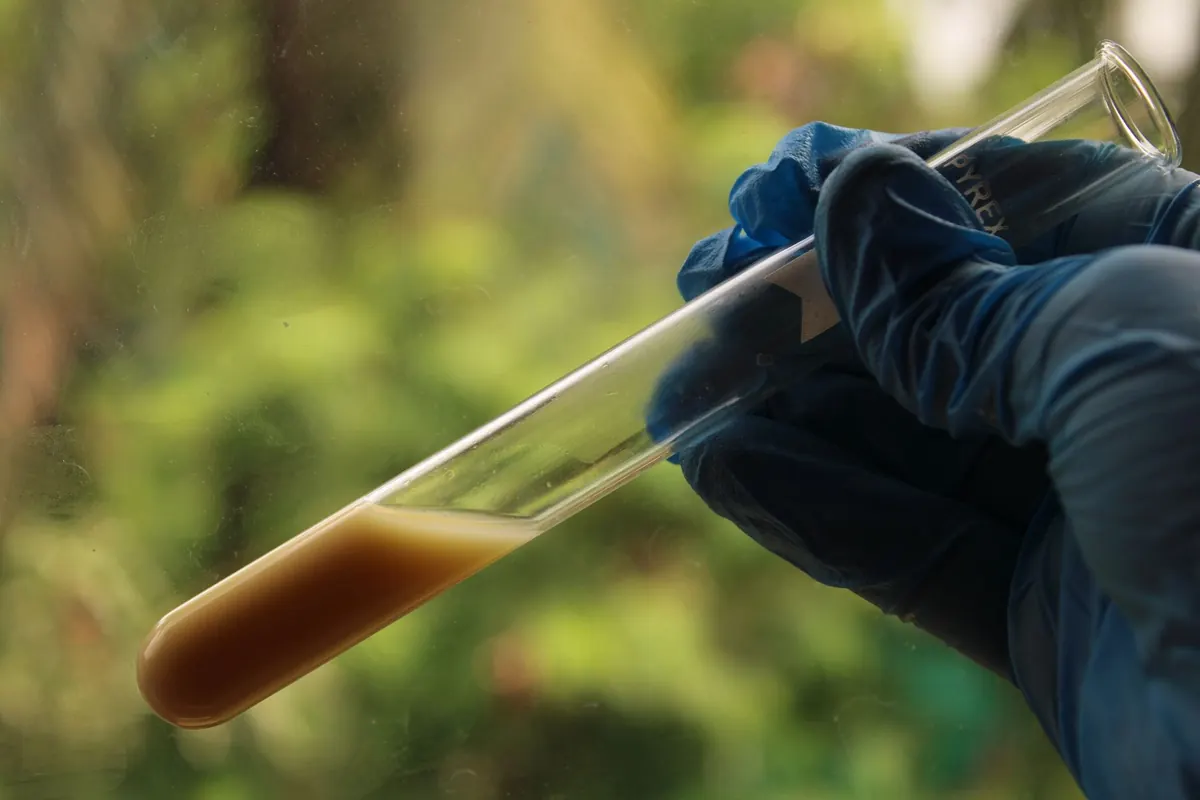
Some of the most useful information comes from a bucket and your eyes. Fill a clear jar at the outlet and let it stand for an hour. Sand or grit settling at the bottom means you need filtration ahead of the drip system. Cloudiness that does not clear suggests fine clay or organic matter. A faint rotten-egg smell points to sulphur and anaerobic conditions in the source. Green slime in the tank or on the filter screen is algae feeding on nutrients and sunlight, and it will find its way into your emitters. Slippery, rust-coloured biofilm is a different problem — iron bacteria — and it usually needs a different response.
Also watch the flow itself. A spring that has slowed noticeably since last year, or that now runs turbid after rain when it never used to, has changed. That is a signal to retest rather than wait for the annual date.
How to Take a Sample That Means Something
- Use the lab's own bottles. For microbial tests, the bottle must be sterile; do not substitute a rinsed jam jar.
- Sample at the outlet or the pump, not from a standing pool, trough or storage tank, unless that is genuinely what you irrigate with.
- Let the water run for several minutes first so you are sampling the source rather than the pipe.
- Rinse the bottle two or three times with the sample water, then fill it, leaving a small air gap.
- Label it with the date, the exact location and the sampling point.
- Keep it cool and deliver it to the lab quickly — microbial results in particular degrade within hours.
Warning Signs to Review Before You Irrigate
Before the season starts, run through a short checklist: any leaf burn at the end of last season, white crusting on the soil surface in the drip line, emitters clogging more than usual, a decline in tree vigour in a block that used to be uniform, or a change in the spring's flow or clarity. Any one of these is a reason to test before the first irrigation rather than after. Two or three together is a reason to test and to talk to an agronomist about what the numbers mean for your soil, your rootstock and your leaching plan.
Keep the reports in a folder with the date and location written on each one. Three or four years of results is worth more than any single report, because trends — a slowly rising EC, a creeping boron figure — tell you what a snapshot cannot.
A Practical Pre-Season Routine
Once a year, before the irrigation season opens, take a full laboratory panel and file it. Once a month during the season, check EC and pH with a handheld meter, and note the readings alongside the date. After any unusual event — a heavy storm, a change in flow, work uphill of the spring — take another sample. Walk the spring and the filter station with the checklist above and write down what you see.
That is a modest amount of effort for a crop you intend to keep for twenty years. Spring water is a genuine asset, and it deserves to be known rather than assumed. Test it, read the numbers against your own soil, and let the orchard's leaf colour and emitter performance confirm what the lab is telling you. For anything involving acidification, gypsum, leaching fractions or a suspected toxicity problem, get local professional advice before acting — the right answer depends on details a general article cannot see.
Photo: Jahra Tasfia Reza / Pexels