

Pollinator-Friendly Almond Orchards: Simple Steps to Support Bees and Beneficial Insects
A practical guide to making almond orchards friendlier for bees and beneficial insects, from bloom-time habitat and water access to careful pesticide use.
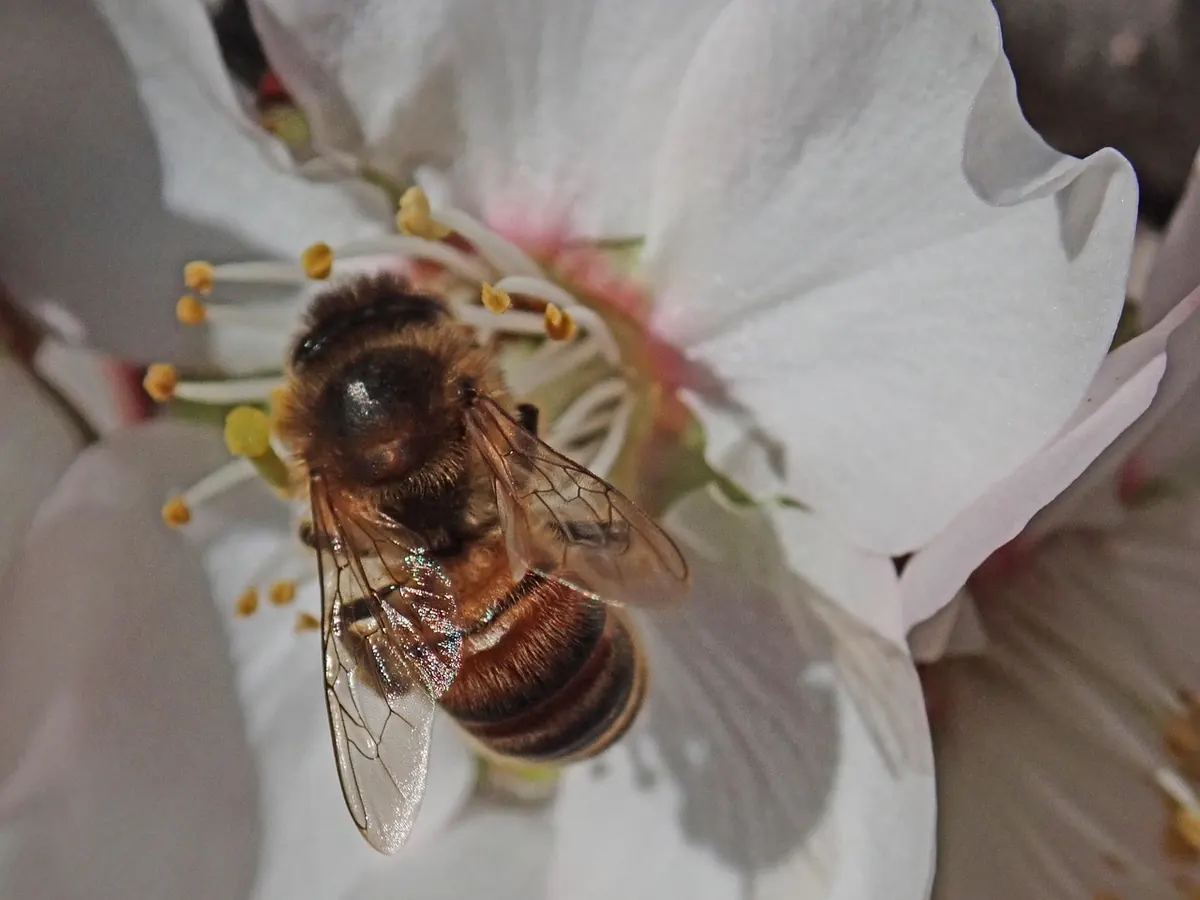
Almond bloom is one of the great spectacles of the farming year. For a few weeks, the orchard turns white and humming, and everything depends on the small winged workforce moving between the flowers. Almonds are largely reliant on pollinators to set a decent crop, so the health of bees and beneficial insects is not a side issue — it is part of the job. The good news is that most of what helps them is modest, affordable and fits into the rhythm of ordinary orchard work.
Pollinator-friendly farming is sometimes presented as a separate project with its own budget and bureaucracy. In practice it comes down to a handful of decisions: what grows under and around the trees, where water collects, when and how sprays are applied, and whether the orchard offers anything to eat once the blossom has gone. Get those roughly right and the orchard becomes a better place for insects — and, more often than not, a more pleasant place to work.
Start with the ground beneath the trees
Many orchards are kept bare under the trees to simplify harvest and reduce competition for water. That is understandable, but a completely clean floor offers nothing to a bee flying through. A modest flowering understorey, even in strips or along the rows, can bridge the gaps between bloom and the rest of the season.
The simplest approach is to leave or sow a low, manageable mix that does not compete aggressively with the trees. In practice, growers often favour:
- Low-growing legumes such as clover, which fix nitrogen and flower over a long period without demanding much height.
- Hardy native or locally adapted flowering species that tolerate mowing and dry summers.
- Narrow flowering strips along headlands, row ends and awkward corners that are difficult to cultivate anyway.
Try not to make it a lawn. A tightly mown grass sward is nearly as poor a habitat as bare soil. If you must mow, do it in rotation — half the strip now, half a few weeks later — so there is always something flowering somewhere. Raising the cutting height by a few centimetres also helps, and it saves a little diesel.
Let a few things go wild
The edges of the orchard often do more for insects than the middle. A rough headland, a hedge left unflailed, a bank of nettles and brambles, a stand of old trees — these are where beneficial insects shelter, overwinter and find alternative prey when the orchard is quiet. They cost nothing except a decision not to tidy them. If the neighbours complain about the look, explain that the rough corner is working.
Hedgerows deserve a particular word. A mixed hedge in flower gives pollinators food before and after almond bloom, and it also slows wind at the orchard edge, which is good for spray drift and for the bees themselves. A hedge cut every second or third year, and cut in late winter rather than in full flower, will give far more back than one trimmed annually to a neat box.
Make water easy to find, and easy to leave
Pollinators need water, and orchards are often thirsty places. Irrigation lines, tanks, dripper lines and troughs provide water, but a bee landing on an open tank or a smooth-sided reservoir can drown or fail to climb out. That matters most in hot weather, when demand is highest.
Practical fixes are cheap. Float a few pieces of cork, timber or straw on open water so insects have something to land on. Keep a shallow tray or a saucer of water with pebbles or stones in a sunny, sheltered spot near the flowering strips. If you have a large open reservoir, a gently sloping ramp of rough timber or stone at one corner gives insects and small animals a route out.
Clean water, reliably available and shallow enough to stand in, is one of the least expensive pollinator features you can add to an orchard.
Check the water source through the bloom period, not just in midsummer. Bloom can arrive with warm, dry days, and a trickle that has dried up offers nothing.
Handle sprays with care around bloom
This is the part where small decisions have large consequences. Almond bloom is precisely when bees are most active in the orchard, and many products used to manage pests and diseases are harmful to them, whether directly or through residues on flowers and leaves.
A few working rules make a real difference:
- Read the label and respect it. Product labels carry the conditions for safe use, including any warnings about bees and flowering crops. If the label is unclear, ask for advice before spraying.
- Avoid applying anything harmful while the crop is in flower, unless the label explicitly permits it for that use.
- Spray in the evening or at night, when bees are not flying, so residues have time to dry and break down before foraging resumes.
- Check the forecast. A calm evening with no rain is better than a windy one that carries drift onto hedges, strips and neighbouring land.
- Keep flowering strips and hedges out of the spray path where you can, and use drift-reducing nozzles and sensible pressures.
- Tell the beekeeper. If hives are brought in for pollination, a short message about what is being applied and when is basic courtesy and good practice.
If you keep your own hives or have a neighbour's on site, agree on a plan before bloom starts rather than in the middle of it. Note that any use of plant protection products should follow local regulations and label instructions; where you are unsure about a specific product or situation, take professional advice from your agricultural adviser.
Think beyond blossom
Bees need more than one abundant crop. Almond bloom is short, and a colony that works it hard needs other forage before and after. A landscape of hedges, flowering strips, untidy verges and neighbouring wild areas is far more valuable than an orchard in isolation, so it pays to look at the wider block, not just the rows you manage.
Aim to have something flowering in early spring, in late spring and in high summer. Early sources might include willows and fruit trees; midsummer sources might include clover, lavender, borage or wildflowers suited to your soil and climate. Mixing a few species is safer than betting on one, because flowering dates shift with the weather.
Give beneficial insects somewhere to live
Predators and parasites — ladybirds, hoverflies, lacewings, ground beetles, solitary wasps — do a lot of quiet pest control that is easy to overlook. Many need shelter rather than food. A rough grass margin, a strip of unmown vegetation, a bundle of hollow stems fixed in a sheltered spot, a few logs left at the edge, and patches of bare, undisturbed ground for ground-nesting species all help.
Leave the soil alone in those corners. Ground-nesting bees need open, well-drained patches and short vegetation; a tidied and mulched border is useless to them. A small sunny bank left bare at the orchard edge is often enough.
A simple walk-through before bloom
A few weeks before flowering, walk the orchard with a notepad and look for what is missing. Does anything flower under the trees? Is there water that insects can actually use? Are the hedge trimmings and spray plans sorted? Is there a rough corner you could leave alone this year?
Then choose two or three changes and do them properly rather than ten half-heartedly. A flowering strip, a safe watering point and a sensible evening spraying routine are a solid first year. Write down what you did and when, so next season begins with evidence rather than guesswork. Over a few years, these small features settle into the orchard and start to look like what they are: ordinary parts of a well-run farm that happens to be good for insects.
Photo: Buntysmum / Pixabay